LIFE. ART. INSPIRATION. A journey into the minds & souls of artists of the diaspora.

Wednesday, October 3, 2012

The Innovator | An Interview with Photographer James C. Lewis

                                                   
                                                          Please 'like' Cultured Artists™ on Facebook! 

James C. Lewis in his studio
When walking into James C. Lewis’ home studio one can be easily captivated by the creative energy that emanates from his meticulously maintained space. His studio holds props and clothing from times past to present day—which he uses to create attention-grabbing photo narratives. I was most fascinated by the many photo albums that were neatly placed about. It was clear that his love and appreciation for photography started long ago—and the pictures, which are historical artifacts themselves—told amazing stories about his life and his family.

Great Great Grandmother Alice Hall with her children & grandchildren (circa 1913) in Statesboro,GA

James C. Lewis' Great Great Great Uncle Judson Lyons 
In a small town called Statesboro in GA, Lewis was born into a rich and well-preserved heritage, where stories were readily passed down from one generation to the next, and history was kept sound through images. Half of Lewis’ lineage can be traced directly back to Nigeria, and he retains the knowledge that a part of his ancestry were never slaves, but came to America by choice.

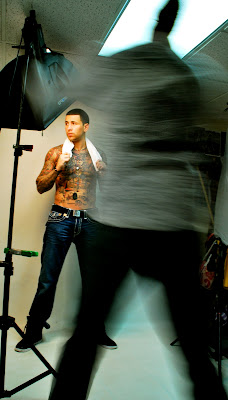
James C. Lewis at work in his studio


His great grandmother’s aunt, Jeane Hall Catlidge (b.1849) however, worked as a slave and was separated from her family at a young age. She was 16 years old when the slaves were emancipated. She told her stories to her family until her death at age 115 in 1964. Although his family (like many African Americans) faced many trials, there were also triumphs. One of the most prominent people in his family was his mother’s great granduncle, the Honorable Judson Whitlocke Lyons. He was one of America’s highest-ranking African American government leaders and was one of only four African Americans to sign US currency, an immeasurable accomplishment for any African American living during those times. Coming from such a varied and noteworthy background, it seems that Lewis was destined to leave his mark on the world.

                                                   
Lewis began drawing at age two. His mother noticed that he had a knack for it when he began drawing pictures in the books around the house. She eventually bought him a sketchbook so that he could redirect his artistic energy, and from there he began to develop his creative skills. He continued to draw through his young years, and at age ten he received his first camera. His father was an avid photographer, and enjoyed it as a hobby. He says of his first Polaroid camera, “With only 10 exposures, you really have to think about what you are going to shoot.” By age 13 he received what he called his first, “real camera.” He remembers seeing it at a yard sale in San Francisco, and being enamored with it. The old woman who was selling it saw his joy and interest, and decided to give it to him. She told him that maybe one day he would become a photographer. Unbeknownst to her, he was already on his way.

In high school he was admitted into a magnet art program, and he began taking more formal art classes, in addition to photography. He won his first art award from the American Press Association for a political cartoon that he created while in his junior year of high school, and that encouraged him to consider art as an optional degree in college. His mother was very supportive of his creative goals, but his father questioned his plans. In order to appease to them both, while finding his own path, he decided to pursue a degree in Visual Communications and Graphic Design because he wanted financial stability, and he felt that photography alone would not allow him that opportunity. Lewis graduated from the Art Institute of Atlanta in 1998.

While working as a Graphic Designer, Lewis photographed weddings, and family events on the side. He thoroughly enjoyed photography, and wanted to challenge himself even more, so in 2007, he joined a website called Model Mayhem. It was on that website that he was able to meet new models, and his creative inspiration began to manifest. By 2008, Lewis, along with millions of other Americans, saw their jobs disappearing, and soon he found himself laid off. Placed in an unstable situation, it didn’t take long before he realized that he could turn to his photography full time. Lewis established his company Noire 3000(N3K) in 2008, and transitioned full time into his photography.

Lewis’ business has grown exponentially over the last five years, with models flying in from all over the country to work with him. He is fast becoming one of the most sought after photographers in the South. Many of the models that come to shoot with him come for the same reason—his innovative creative style. He shoots models from all backgrounds for business and commercial purposes, but his niche is his creative photography—which he uses to tell fascinating stories or deal with political and emotional issues. 

                                       
Lewis says that what he shoots, and how he shoots sometimes happens organically, and he often, “feeds off of the energy of the models.” He says that 75% of an image is based on having the right model and lighting. When he creates, he wants viewers to be shocked enough to ask questions, because for him, dialogue about the topics are important. Although Lewis works with models of all races, many of his photos features African Americans in positions of strength and power. “ I am driven to enlighten the younger generation about who we really are as black people…and depict us the way we should be portrayed.”

His current series, which he calls, Yoruba African Deities, features his interpretations of the African Orishas from the Ifa religion of Nigeria. His choice to create this series may have been a subconscious homage to his Nigerian heritage, but his true goal was to tell the story of the Orishas who inspired much of the Greek mythology that we have come to know. This series is a powerful and enlightening series that features astoundingly beautiful imagery of Africans and African Americans.


Lewis has worked on several series, some dealing with politics and others dealing with sexuality. His photographic series, Naked Black Justice, features a compilation of images and videos of African Americans with words and slogans written on their bodies. These words deal with the many stereotypes that African Americans face simply because of their skin color. The videos show a more in depth and personal experience with the models chosen for the series. They show an emotional and captivating view of life through the eyes of others.

Another series—Androgyny with a Twist—discusses sexuality and individuality. Lewis plays with society’s perception of what is perceived to be normal in order to evoke emotion and dialogue.
For Lewis, being a photographer is a challenging yet highly rewarding career. Although he loves his craft, he often feels that others take for granted the amount of time and effort that he puts into his photography. He says the worst insult that one could ever give a photographer is telling them that they have a good camera, and he equates it to telling an artist that they have good brushes. Lewis shoots and edits his own work because he wants to produce his art from, “conception to completion.”
James C. Lewis is an ingenious creative who is refining his skill by breaking the rules, and setting new standards. He truly is an innovator who trusts his instincts and dances to the beat of his own drum, and others are truly taking notice.


Final images from the shoot in studio with model, Chris McDowell


“If you are going to do this make it your own.”
James C. Lewis, 2012


You can find his work at www.noire3000studios.com and to see more images of his Orishas follow him here.
Please check out the in studio visit with James and his model, Chris McDowell in the video below.


You can catch up on all of N3K's youtube videos here.

 All images are © copyrighted by the artist unless otherwise noted. Images cannot be reproduced without permission of the artist. 
Cultured Artists™ ©2012
Read More

Wednesday, September 5, 2012

The R(EVOLUTION)ARY | An Interview with artist Kevin A. Williams (W.A.K.)


Please 'like' Cultured Artists™ on Facebook! 
Artist Kevin A. Williams (W.A.K) in his studio
The execution of the perceptions of the mind is often the most challenging part of being an artist. Many artists limit themselves to what is easily understood, and easily created, but some face the challenges and venture out unto unknown paths. Artists such as these tend to make a marked impact on the lives of the viewers of their works, and carve a definitive niche for their own legacy. Kevin A. Williams (W.A.K) is that artist—one that is always evolving and cultivating his craft—while inspiring others to do the same.


When I walked into his studio there was a massively beautiful seascape on his easel. He was still working on the piece, but had stopped to finish up a conversation with a colleague. Although I was completely enamored with the painting, I overheard a few of his last words, “Baptism by fire!” he evoked, “Baptism by fire!”   As I looked around his studio I thought that Baptism by Fire was indeed a definitive way to describe the artistic journey of a man that seemingly started out very conventionally.


Williams was born into a loving family on the south side of Chicago. Although the urban landscape crafted some sketchy inhabitants, Williams’ home life was his oasis. He was inclined to draw at an early age, and would often find himself drawing from comic books with friends on his porch. As pre-teens, they would replicate the images and compare them amongst each other. When he was not with his friends he was with his sisters and aunts. Williams says being surrounded by his sisters and the ladies in his family prompted him to begin drawing pictures out of fashion magazines because that was all he had to choose from. At an early age he began to develop a taste for fashion and design.

     
By the time he began high school at Chicago Vocational, he was taking architectural drafting classes. Although he enjoyed creating art, and designing, Williams said that he never believed that he could have a true career in art. Architecture seemed to be the only respectable way to put his talents to work. One day, while distracted by doodling in class, his instructor warned him that his behavior could lead to failure. The instructor tried to encourage him to pay more attention, so he suggested that he could earn extra credit by drawing him a picture of his dog. Williams gladly accepted the job, and after completing the portrait, his instructor showed the drawing to the art teacher who taught in the commercial art department across the hall. The art teacher immediately recognized Williams’ gift and tried to inspire him to pursue a career in commercial art instead of architecture.
                     
                         A piece in progress in W.A.K's studio
In W.A.K's Studio

Williams recalls the experience, “ I blew it off…I told him I wanted to go to DeVry!” The persistent instructor, artist Robert Johnson, called Williams parents and was able to set up a meeting. Williams father, a mathematician, was uninterested in hearing about a career in the arts until the teacher told him that Williams could receive scholarships for his talent. Open to the idea of scholarships, his parents encouraged him to create more. He won many contests and awards, and soon the universities began to pay attention.

Taking her back ©1995, Kevin A. Williams/WAK
Mother Earth ©1995,  Kevin A. Williams/WAK

With scholarship offers coming in from all over the United States, including The Art Students League of New York, and Parsons, Williams became overwhelmed. Instead of joy, he felt hesitance about moving away from his parents and going to New York City. He also felt that he lacked the discipline to travel so far away from home at such a young age. He eventually chose to study at the Art Institute of Chicago because it was closer to home. Although the Art Institute was in his hometown, he was taken aback by the students, and the eclectic environment of the school caused Williams to experience what he calls, “a culture shock.” He left after one semester and ended up at Columbia College studying as he says, “everything except art.” Eventually (to his father’s dismay), he made a decision drop out of school. He felt that much of what he needed to learn creatively could not be taught in school and wanted to venture out on his own. With his entrepreneurial spirit leading the way, his focus for many years was on proving to his father that he could survive despite the challenges he encountered.
Versace, 2012 © Kevin A. Williams/WAK


Williams had always had great business acumen—he had learned much of it from his father—so when he began soliciting customers for drawings and advertisements at the age of 15, he had his father’s full support. He became more aggressive with his business venture after leaving college, and began to approach hair salons about producing their signage. Along with the hand painted signage; Williams included a drawing on each sign. Soon he was asked to draw images of the hairstyles, and the salons soon became his new clientele. He began to see his vision and taste for fashion manifesting in his life.
Foxy, © Kevin A. Williams/WAK

As a young artist trying to find himself, Williams faced the idea of failure and disappointment head on. It was during his most challenging times that he developed his well known moniker W.A.K. W.A.K developed from a sense of failure and defeat in his early journey as an artist because he was ashamed of his work, and didn’t want to use his real name. Soon it would come to mean wisdom and knowledge, and would become symbol of his achievement in the art world.
"The Catch," on the Easel, © Kevin A. Williams/WAK 
The Catch, © Kevin A. Williams/WAK
At age 19, he began working with Soft Sheen as an illustrator for their hair care product line. He worked with their ad agency Brainstorm, and it was there that he learned how to master the skill of drawing hair. Not long after working there, a fallout with an influential stylist and mentor left Williams, “blackballed,” and unable to work with anyone in the hair and fashion industry. Undeterred by the setback Williams decided to create his own path.
The Worst Sight...Generations Lost © Kevin A. Williams/WAK
He was still dealing with major financial and creative struggles in 1995 when he sat down with a friend for lunch. He says that he remembers splitting the bill to save money. It was in that moment that he made the decision that he was going to put the word struggle and any thoughts of it behind him, and focus solely on his future. That year he painted, Taking her Back (which was inspired by a Calvin Klein ad), as homage to black women. Along with his business partner who was a gallery owner, Williams’ work began to sell at art expos, and in the gallery. He took his piece to an exhibition in New York called Circle of Sisters, and it was there that his painting, Taking her Back, and the prints he made from it, became popular. Another bestseller was his piece, Mother Earth. That exhibition in New York opened the door for what would be a fulfilling and fruitful career. He finally felt that he had made a true connection with the people, and he was encouraged to create more works that would inspire. Over the years he has created works that focus on the spirituality, sexuality, and the strength of black people. He believes that as multi-dimensional people, there needs to be imagery that represents that.

The Right, in progress © Kevin A. Williams/WAK

The Right, © Kevin A. Williams/WAK
Williams says that there have been many times that he felt like quitting. He jokes, “ Every time I felt like quitting, I thought to myself, what if I blow up next week?” With jokes aside he shared that he felt the need to say something important with his art, and despite his fears, he knew that he had to carry on. He still deals with insecurity, but he now embraces it. He believes that it allows him to never get comfortable, and he continuously challenges himself to be better.
Kevin A. Williams at work in his studio © Cultured Artists™ 2012
Many of his older works were created using ink, and airbrushing techniques, along with acrylic paint. As a part of his new creative journey, he has transitioned from commercial art to fine art. Fine art was something that he had always been interested in, however when his pieces became popular commercially, it was difficult to go back to it. He says of the transition, “I had heard that it was impossible to move from commercial art into fine art…they told me I couldn’t do it…that was just the fuel I needed to make it happen.”
The Fishermen, © Kevin A. Williams/WAK
“Baptism by fire,” are the words he uses to describe stepping into the unknown. Jumping into the proverbial fire, and risking the burn, is sometimes the only way that an artist can find their true selves. Many artists are unwilling to take to risks, and some refuse to sacrifice for the love of their art. At a young age, Williams made a decision to do something that others told him couldn’t and shouldn’t be done, and he continues to push the boundaries today. His current body of work is an evolution from the name and business that he has built for the last 20 years. Although he doesn't plan to retire WAK, his new K.A.Williams line marks a new beginning for the artist.
The Worst Sight, King © Kevin A. Williams/WAK
He began to create what he deemed to be “timeless” pieces, using a new and different medium, oil. He describes the K.A.Williams line as a novel written from the perspective of the people of African diaspora. With imagery from the civil rights era, back to the moments before Africans were enslaved, his paintings capture a new view. These recent pieces in his new line feature imagery that shows, “the posture of a people before they were broken, and interrupted from their daily work by intruders.” Williams says that he is inspired to create images that show black people as proud, protective and superior beings as opposed to the common and incorrect imagery that show weakness, oppression and submission.
Strong am I, © Kevin A. Williams/WAK

As an ever-evolving artist, Williams’ focus is on personal growth, and the empowerment of his people through his art. He has seen his art change over the years, and feels that his newest work more clearly defines the direction that he is headed in. The connection that he feels to his art developed from the successes and failures that he has faced throughout the years, and he is still amazed by his gift, and his own evolution.“Each painting to me, clarifies the distortion between me and my true self…I feel more liberated every time I paint because I am not submitting to what people are telling me to do…I’m doing what I want to do.”
 
The Sound of Serenity, © Kevin A. Williams/WAK
Beautiful Breeze, © Kevin A. Williams/WAK

He leaves poignant words for emerging artists:
"Be yourself, find your voice, your content, a living record of what you had to say when you were here. Don’t say something that someone has already said, the same way that it has already been said."
The Washerwomen, in progress © K.A.Williams, 2012

Kevin A. Williams (W.A.K) is not just an internationally recognized artist, he is also my friend and mentor. Over the years he has taught me a lot about precision and mastering my skill, but more than anything I am most inspired by his value system—his will and drive to succeed against all odds, and his focus on constant growth. You can find many of his pieces and images at www.wak-art.com, but to see his newest fine art work, please visit www.kawilliamsfineart.com.


Artist Kevin A. Williams (WAK) in his studio © Cultured Artists™

“Art will give you back what you put into it. It will reward you over and over again.”
                                                                            Kevin A. Williams (WAK), 2012


Check out some our conversation in his studio in this Youtube video:


 All images are © copyrighted by the artist unless otherwise noted. Images cannot be reproduced without permission of the artist. Cultured Artists™ ©2012
Read More

Wednesday, August 1, 2012

The Geechee Contemporary | A Conversation with artist, Leroy Campbell


                                                             Please 'like' Cultured Artists™ on Facebook! 

Leroy Campbell was born into the rich culture of the Gullah people of Charleston, South Carolina in 1956. His heritage—overflowing with a vital history and language—would play a significant role in his art in later years.

© Leroy Campbell

In his young years he found that he was subconsciously drawn to art so he spent a lot of his time ‘doodling’ on desks and clothes. Despite his ‘doodling,’ Campbell wasn’t particularly driven to create art professionally. Years after high school he took a job working in a nursing home. He had moved from South Carolina, and was now living in New York City.

© Leroy Campbell
It seems that art was pursuing Campbell (unbeknownst to him), and wherever he went, it surrounded him. The nursing home, by which he was employed, had an art gallery, and from time to time, new art would hang there. On one occasion in 1984, the company held an employee art exhibition. Campbell says that he placed several pieces in the exhibition, and when he sold them for $15 each, he was thrilled. After those sales, Campbell started to recognize his talent, and though he received a high level of support and encouragement from his co-workers about his art, he was more focused on growing in the career that he was in. Campbell enrolled in one of the top creative schools in the United States, Pratt Institute, however, he wasn’t there to study art, he had enrolled in a Dietary Therapy Program. 


Divine Order © Leroy Campbell

When he returned from school during a break, he realized that the company he worked for was on strike, and massive changes were happening with his job. One of supervisors, who was always exceedingly supportive of his art, offered him a position as an art teacher at a new community organization that he was opening. Elated by the offer, and the encouragement of some of his classmates at Pratt, Campbell was finally motivated enough to venture out with his art.


No Man Band © Leroy Campbell

Some of his classmates offered to sell his works in downtown Brooklyn, and after some of his first sales—moving pieces for $12 to $15—he decided that he wanted to be around more artists. He was no longer employed with the company, and could no longer attend school (because his job was paying for his education), so he delved more deeply into what he had always loved. He took his art to West 4th Street where he found new and abundant clientele...and soon he ended up selling art in The Village. It was there that an unexpected art career began to grow for Campbell. He connected with other artists, and together they had shows. He was able to network with art galleries for exhibitions, but it wasn’t until he connected with a publishing distributor that his name became more public. They highlighted and marketed his work in different venues, and soon his art began to become popular in many art communities.

Release © Leroy Campbell

Campbell is well known for his silhouetted Mannerist style images, with elongated necks, legs and arms. He says that his art has, “Spiritual underpinnings.” His style inspiration came from the notion of using stick figures, and also from images he saw in the silhouetted introduction of a television show called, ‘Saints.’  He was also greatly inspired by the stylized art of Ernie Barnes. Campbell’s early works were all paint, but his recent works are laden with mixed media elements like paper, fabric, found objects, and recently old African American Newspapers.  His collage inspirations came from two of the artists who influenced his work the most, Jacob Lawrence and Romare Bearden.


On a trip to Washington D.C., Campbell fell in love with the art of Jacob Lawrence, and three years later he was able to speak to him briefly about his life and art when Lawrence spoke at Pratt Institute in Brooklyn. “Meeting Jacob Lawrence made a profound impact on my life, and helped to confirm my place in the visual arts community.”

Self Educate © Leroy Campbell
Peace of Mind © Leroy Campbell
               
He says that his goal as an artist is to praise the human spirit, and he wants to encourage people to do things, “in spite of.” Many of his stylized images reflect the ideologies of the Gullah culture from a contemporary perspective, and through his most recent series, “The Newspaper Series,” he deals with some of the history and meaning of newspapers in Gullah tradition. In Gullah tradition, newspapers play a significant role in protection from evil and benevolent spirits. Many of his pieces feature imagery reminiscent of his childhood living in the south, and his adult life in New York City. His goal is to show the viewer that we are all connected notwithstanding locale and time.

Hand in Hand © Leroy Campbell
Campbell says that he doesn’t believe in the concept of 'starving artist', because there are always ways that an artist can make money, even if they have to work a formal job in the meantime. He believes passionately that artists need to create not only for themselves, but for humanity. Campbell believes that if you create art solely for money, you can easily loose track of your greater purpose. He says of his art, “These images are my way of reexamining some of the moments that have helped to shape African American culture, and render us whole.”

Art History  © Leroy Campbell

Leroy Campbell is an internationally recognized visual artist, who has been collected and printed extensively in America and abroad. When he is not traveling and speaking, you can find him most often in his studio creating emphatically and passionately.

To learn more about this artist please visit his website here, http://www.leroycampbelloriginals.com/

     “Whatever you are looking for is looking for you."
- Leroy Campbell 2012

 All images are © copyrighted by the artist unless otherwise noted. Images cannot be reproduced without permission of the artist.
 Cultured Artists™ ©2012

Read More

Friday, June 1, 2012

The Incomparable Artist, Mr. Sylvester Sims


   Please 'like' Cultured Artists™ on Facebook!

Images © by WUWM 89.7 FM

There are some artists that affect your life instantaneously—their light and generosity shines brightly through them. As a young artist in Milwaukee, I felt immediately connected to Mr. Sims, upon first meeting him. I was struck by his genuine kindness, and his willingness to welcome me into his home.

Sylvester Sims was born December 21, 1928, and is a well collected and accomplished visual artist living in Milwaukee, WI. A self-taught master artist, he is the winner of the 23rd annual Black Excellence Award, and numerous awards throughout Wisconsin. He is also an integral part of Wisconsin Black History. His story of triumph and passion came before his amazing creative journey.

Images © by WUWM 89.7 FM

Sims competed in swimming (High Diving), Weight lifting, Amateur Boxing, Track, and Semi pro Football. In 1943 he won the Bronzeville Swimming and Diving competition. In 1944 he pulled off an upset by winning the state AAU High Diving Championship. Sylvester Sims became the first black man in Wisconsin history to win a High Diving Championship. [1]

Images © by WUWM 89.7 FM


Upon entering his home, he was kind enough to share with me a view of his studio, which was impeccable. He had amassed a large amount of paintings and drawings over the years, many of them awe inspiring and skillfully executed. It was clear that he was a deeply fervent artist. There was a portrait sitting on his easel, and he sat down in his neatly kept studio to show me how he mastered the oil paint.

© Sylvester Sims

Many of his paintings were portraits, some people he’d known, and others that he’d imagined, and trickled in were a few remarkable landscapes. His masterful renderings captivated my young eye, and I realized that the level of skill that it took to create those pieces was something that I had only dreamed to achieve. After leaving his studio, he took me downstairs to give me a print of one of his charcoal drawings. He was adept at several mediums. His basement was stacked from top to bottom with canvasses, and there was even more art neatly placed about, and easels with larger works in progress.

© Sylvester Sims


That day as I sat with Mr. Sims, and listened to him passionately talk about his art and his family. I didn’t know if I would ever see him again because shortly after, I left Wisconsin. Mr. Sims left an indelible mark on my heart and mind. I realized that creating is less about the money you make, but more about the passion within, the drive to express something deep within oneself. His work captures the human spirit; the essence of what connects us all.

Images © by WUWM 89.7 FM

Images © by WUWM 89.7 FM

Mr. Sylvester Sims continues to create well into his 80’s, but he is currently facing the most challenging battle of his life. My heart is with him and his family during this difficult time.

His light continues to shine to inspire other artists to pursue their passions from an authentic place and his works are a continued reminder of his success, and gift to the world.

Images © by WUWM 89.7 FM


Images courtesy of and copyrighted © by  http://www.flickr.com/photos/wuwm/ unless otherwise noted.

            To see more art by Sylvester Sims visit http://www.theeartguild.com/color.html

Here is a video of Mr. Sims at work :


All images are © copyrighted by the artist unless otherwise noted. Images cannot be reproduced without permission of the artist.
 Cultured Artists™ ©2012


Read More

LIFE. ART. INSPIRATION. A journey into the minds & souls of artists of the diaspora.

Tamara Natalie Madden 2011-2016. Powered by Blogger.

About me

Looped Slider

Followers

top social

top navigation

Instagram

Pages

Twitter Updates

Latest Post

Get In Touch

Popular Posts

LATEST POSTS